Labels

Wednesday, April 13, 2011

Eagle Rock Energy acquires Crow Creek Energy for $525 million!! Cana Shale acreage runs at ~$5,000/acre.

Eagle Rock Energy Partners LP agreed to acquire all of the equity interests in CC Energy II LLC with reserves located in multiple basins across Oklahoma, Texas and Arkansas, for total consideration of $525 million. The total consideration includes approximately $303 million of Eagle Rock equity to be issued to the sellers, $15 million of cash and $207 million of assumed debt.
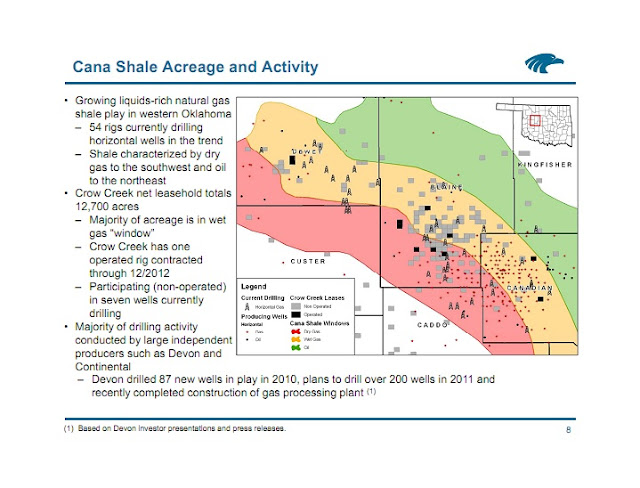

Highlights of the Crow Creek properties include the following:
  • Net production in the first quarter of 2011 of approximately 47 MMcfe/d
  • Total proved reserves of 268 Bcfe (80% gas and 66% proved developed)
  • Total 3P (proved, probable and possible) reserves of 740.5 Bcfe
  • Core operating areas include 327 operated wells and 1,040 non-operated wells on approximately 115,500 net acres across the Golden Trend Field, Verden Field and the Cana Shale Play
  • 182 proved drilling locations and more than 450 probable drilling locations
  • Approximately 12,700 net acres with 434 identified drilling locations in the emerging Cana Shale play in Oklahoma. This area has recently experienced a high level of horizontal drilling activity, with 54 rigs currently active across the trend
  • Reserve life index of over 20 years
  • 75% operated (based on 2011 expected production)
  • Assumption of Crow Creek Energy's current commodity hedges which had a mark-to-market value of approximately $10.8 million as of April 6, 2011.


Cana Shale at ~$5,000/acre is booming up like senior shale gas producers!

The following slide from Cimarex gives the economics of Cana Shale well


Cana is the world’s deepest commercial horizontal shale play (11,500 – 14,500 ft TVD). The active operators of the play include Cimarex Energy, Continental Resources and Devon Energy. Cimarex Energy holding 100,000 net acres in Cana Shale play had drilled 112 gross wells in 2010, completing 86 of these. In 2011, Cimarex Energy plans to drill 100 gross wells equipping 8-9 rigs. Cimarex’ estimated 2011 drilling capital allocated for this play is $340 million. Devon drilled 87 new wells in play in 2010, and plans to drill over 200 wells in 2011.

With the industry players’ increasing interest in Cana Shale play and a new metric milestone set at $5,000/acre, Cana play is yet to magnetise many more oil and gas players. Cana Shale play - the new born shale is booming well!

The following snapshot shows the other significant deal in Cana Shale.


Vermilion 2011 April Investor Relations Presentation

- Anticipate production growth to between 45,000 to 50,000 boepd by 2015

2010 Drilling activity:
- 13.9 operated wells in 2010 (A Quality)
- 5.3 net non-operated wells in 2010
- Tested water based frac in Q4-2010
- 2011 Budget 30 to 35 net wells
- 17 operated wells (A Quality)
- 6 operated wells (B Quality)
- 10+ net non-operated wells

http://docsearch.derrickpetroleum.com/pageNav/view1/docId/11837-0000/Vermilion-2011-April-Investor-Relations-Presentation.html

2011 dealmaking off to a good start in Q1

In Q1 2011 Global upstream M&A activity totalled $52.4 billion in 174 transactions. That was down 37% from the record set in Q4 2010 of $84 billion, but still sets the pace for a second straight year of more than $200 billion in deals. 


North America emerged as the most active region for deal making, followed by FSU                 North America again led the way with 112 transactions totalling $21.2 billion, for 41% of global deal value. The Former Soviet Union ranked second with 12 deals totalling $15.4 billion. Asia saw $7.5 billion and Africa $6.8 billion. Deal making was relatively quiet elsewhere with announcements for Australia, Middle East, Europe (and the North Sea) and totalling less than $1 billion. Transaction value in South America dropped to $1.1 billion in Q1 from a record $23.5 billion in the prior quarter.


Russia led all countries with $14.7 billion of value changing hands
Russia led all countries with $14.7 billion of value changing hands in six transactions, followed closely by the US at $12.8 billion in 67 deals. Canada was third with $8.3 billion in 45 transactions. Three fourths of the value was in the 10 largest transactions, which totaled $39.3 billion and involved 18 companies from 12 countries, reflecting the diversity and competitiveness in upstream M&A. 


BP shifts to growth mode in 2011, did two major acquisition
National oil companies continued to play a prominent role, active in five of the eight largest transactions. BP was in the two biggest deals, leveraging its expertise to work bold deals with India’s Reliance and Russia’s Rosneft for offshore exploration and development stakes. In India BP took a 30% interest in 23 Reliance-operated offshore PSCs for $7.2 billion and formed a 50:50 joint venture with Reliance to source and market natural gas in India.

Rosneft and BP announced a $7.2 billion share swap and an agreement to jointly develop three highly prospective arctic blocks covering 48,000 sq mi in the Kara Sea, roughly equivalent to the prospective area of the UK North Sea. Slighted TNK-BP shareholders sued to stop the deal, Stockholm TNK-BP ruling puts BP Rosneft deal on ice.


CNPC signed the largest shale gas JV till date
In the largest shale-gas JV to date, Chinese major CNPC committed $5.4 billion to a 50:50 venture with Encana to develop Encana’s Montney shale play and other assets in the Cutback Ridge area in western Alberta and eastern BC. That positions CNPC as a potential LNG exporter from Canada’s West Coast.
In other Canadian shale action, South African synfuels major Sasol doubled up on its $1.1 billion Montney JV with Talisman in late 2010, announcing a second $1.1 billion Montney JV with Talisman just 25 miles north of the first.


BHP made its first move into North American unconventional plays
In the US, BHP snatched up Chesapeake Energys Fayetteville shale assets for $4.7 billion in the Australian resource giant’s first move into North American unconventional plays. Until now BHP’s US focus has been almost entirely on the deepwater Gulf of Mexico. China’s CNOOC Ltd kicked off what could be a spate of Niobrara JVs with a $1.3 billion deal involving Chesapeake, at $4,700/acre. Korea’s KNOC closed out the quarter with a $1.5 billion Texas Eagle Ford JV with Anadarko for liquids-rich acreage, setting a new benchmark of ~$13,000/acre for that play. In corporate-level M&A, there was a continued brisk pace of equity sales or swaps. Abu Dhabi’s state-owned International Petroleum Investment Co bought an added 53% in Spain’s CEPSA from Total for $5 billion. Undeterred by Russian politics, Total moved to buy a 12% stake in Yamal LNG operator Novatek for $4.1 billion, with an option to go to 19% within 36 months. Total simultaneously announced the acquisition of a 20% stake in the Yamal LNG project, which targets first output in 2016 and a potential 15 MMmt/yr of LNG. In other Russian deals, ConocoPhillips sold its remaining $1.2 billion equity stake in LUKoil in an ongoing restructuring effort.


Oil or gas?
Gas-related transactions in Q1 totaled $26.3 billion for half of transaction value. Oil deals were $22.6 billion for 43%. Deals with a mix of oil and gas were only 6%, their lowest share since 2009. This may reflect company efforts to rebalance portfolios from one commodity to the other.

Top 20 deals in Q1 2011


Tuesday, April 12, 2011

Gran Tierra Energy increases 2011 capital program to $355 million; Raises production outlook; Plan to drill 38 wells in Colombia, Brazil, Peru and Argentina


Gran Tierra Energy increases 2011 capital program to develop recently acquired assets in South America. The company intends to spend approximately $55 million on the newly acquired assets with approximately $25 million in Colombia, $14 million in Peru and $16 million in Argentina.


Gran Tierra acquired Petrolifera Petroleum in a $195 million deal in January 2011, bringing together a pair of Canadian-based companies exploring for oil in South America.


Including the Petrolifera assets, Gran Tierra sees average production of between 17,500 and 19,000 barrels of oil equivalent per day, net after royalty. In late December, the company had forecast production of 16,000 to 18,000 boepd net after royalty. The company, which has assets in Colombia, Argentina and Peru, raised its capital expenditure for the year by about 19% to $355 million.

In Colombia, Gran Tierra Energy intends to delineate a potential gas production platform in the Lower Magdalena basin, prepare for 2012 exploration drilling in Peru, and reverse production declines in Argentina where both oil and gas prices have consistently been rising.

Colombia
Gran Tierra Energy plans to spend approximately $14 million on drilling in Colombia, including one exploration well and one delineation well with the intention of evaluating a potential gas production platform in the Lower Magdalena Basin.

Peru
In 2011, Gran Tierra Energy intends to spend approximately $13 million in preparation for drilling in early 2012.

Argentina
Capital spending in Argentina will initially focus on reversing production declines on properties in the Neuquen Basin. Gran Tierra Energy plans to spend $14 million on drilling and completions in Argentina.

Imperial Oil to divest certain Alberta assets

Imperial Oil Resources has initiated a process to divest certain of its assets in the Medicine Hat area (Redcliff-Schuler) in Alberta, and has retained Scotia Waterous as its exclusive financial advisor to assist in this process. The Redcliff-Schuler offering represents an opportunity to buy conventional, long-life shallow gas production.


Offering Highlights:
Redcliff area overview:
-- 88% working interest in the Redcliff producing assets
-- Raw production of 3.2 MMcf/d as of January 2011; 100% of production is operated
-- Partners include Enerplus, ConcoPhillips Canada Energy Partnership and the City of Medicine Hat Gas Department
-- Main producing formations include the Cretaceous Medicine Hat and Second White Speckled Shale (shallow depth of ~600 mKB)
-- Potential to capture incremental gas with low cost infill drilling locations
-- Majority of Redcliff leases are developed with 4 to 6 wells/section; Nearby operators (Cenovus and Direct Energy) have drilled up to 16 wells/section
-- Imperial Oil has extensive infrastructure in the area; Operated with a 100% ownership in two compressors; Gas does not require processing beyond dehydration and compression; Custody transfer at the compressors.

Schuler area overview:
-- 100% working interest in the Schuler Medicine Hat Gas Unit
-- Raw production of 2.7 MMcf/d as of January 2011; 100% of production is operated
-- Unitized formation - Cretaceous Medicine Hat (shallow depth of ~ 600 mKB)
-- Includes interests in non-unitized formations on a portion of the lands
-- Potential to capture incremental gas with low cost infill drilling locations
-- Majority of Schuler leases are developed with 4 to 6 wells/section; No Unit drilling activity since 2007
-- Offset operators (Direct Energy, Enerplus and Nexen) have drilled up to 16 wells/section; Extensive infill drilling by other operators in the area in 2008-2009
-- Production is pipelined to Direct Energy’s compressor and dehydrator at 13-07-016- 01W4; Custody transfer meter upstream from the compressor

KazMunaiGas EP spends $40 million to grab four Kazakhstan blocks!

JSC KazMunaiGas Exploration Production (KMG EP) has reached an agreement with the JSC National Company KazMunayGas (NC KMG) to acquire four hydrocarbon exploration contracts. As per the agreement, KMG EP acquires the following four contracts: Temir, Teresken, Karaton-Sarkamys and the territory adjacent to Uzen and Karamandybas. The acquisition cost of the four contracts is $40 million. According to the company’s estimates, the geological resources on four blocks are around 1.5 billion barrels of oil equivalent.
Temir and Teresken blocks are located in the Aktobe region in close proximity to the assets of Kazakhoil Aktobe LLP and Kazakhturkmunai LLP, as well as other assets, which may be of interest to KMG EP. The geographic location of the contract area has several advantages, including infrastructure and logistics. The territory adjacent to Uzen and Karamandybas is located in the area of operations of Uzenmunaigas production facility. Block Karaton-Sarkamys is located in the Atyrau region 100 km south-west of the Kulsary deposit in the area of operations of Embamunaigas production facility.
The terms of the contracts on the territory adjacent to Uzen and Karamandybas, Karaton-Sarkamys block and Temir, is 6 years from 2010, with the right of extension until 2019. With regard to the Teresken block, the license is for 6 years, starting in 2006, with the right of extension until 2015. Significant synergies can be achieved through the use of the existing infrastructure of Embamunaigas and Uzenmunaigas production facilities in Atyrau and Mangistau regions, which will help to optimize capital and operating costs.

KazMunaiGas E&P will continue to acquire onshore Kazak assets!
In March 2011, KMG EP signed an approximately ~$150 million deal to acquire 50% interest in Fedorovsky block in Kazakhstan. This is followed by the $40 million deal with NC KMG. In line with their strategy of acquiring selective onshore assets in Kazakhstan, KMG EP is open for additional acquisitions.

The $150 million deal in detail- 


Source: Derrick Petroleum E&P Transactions Database

Monday, April 11, 2011

Shell acquires ~A$2 billion worth stake in Wheatstone LNG project from Chevron!

Chevron has signed agreements with Shell regarding the A$30 billion Wheatstone Project as a natural gas supplier and equity participant. Under the unitization agreement with Chevron's Australian subsidiaries, Shell will assume an 8% participating interest in the Wheatstone and Iago natural gas fields in the Chevron-operated permits WA-253-P, WA-17-R and WA-16-R, located offshore northwest Australia. The Wheatstone and Iago gas fields will supply Trains 1 and 2 of the Wheatstone Project, located onshore at Ashburton North in Western Australia. Shell will also assume a 6.4% participating interest in the project facilities, with Chevron remaining project operator with 73.6% stake. Financial terms weren’t disclosed. However, the media sources are estimating the value of the stake to be around A$2 billion.


The front-end engineering and design activity on the Wheatstone Project is nearing completion. A final investment decision is expected in the second half of this year once environmental approvals and other associated agreements are finalized with various levels of government. The first phase of the Wheatstone Project consists of two LNG processing trains with a combined capacity of 8.9 MTPA and a domestic gas plant. The project is expected to come online in 2016.

Try this free document search tool

Asian customers for Wheatstone LNG!!
Apache and KUFPEC hold 13% and 7% stake, respectively, in the project. Chevron Australia managing director Roy Kryzwosinski said Chevron planned to divest more equity in Wheatstone to its foundation customers, including KOGAS and TEPCO, but its interest would never fall below 50%. Chevron is in negotiations with its Wheatstone customers TEPCO, KOGAS and Kyushu Electric, which are also set to take equity stakes in the project, said Chevron's spokeswoman. The three Asian LNG buyers have inked deals to lift 4.1 million mt/year, 1.5 million mt/year and 700,000 mt/year of Wheatstone LNG respectively.


Asians hunger for LNG will continue!!

The Asian spot LNG prices settled at $11.6/MMBtu in the last week of March 2011. Approximately 60% of the global LNG is delivered to the Asian markets. The Wheatstone project notably has three Asian customers (nearly 80% equity LNG under contract). With the high LNG prices and strong Asian market conditions, the project is in a robust state!! In addition, Shell's entry into the project will speed up the project's development pace. 

The following snapshot shows the LNG deals of 2010-


LinkWithin

Related Posts Plugin for WordPress, Blogger...